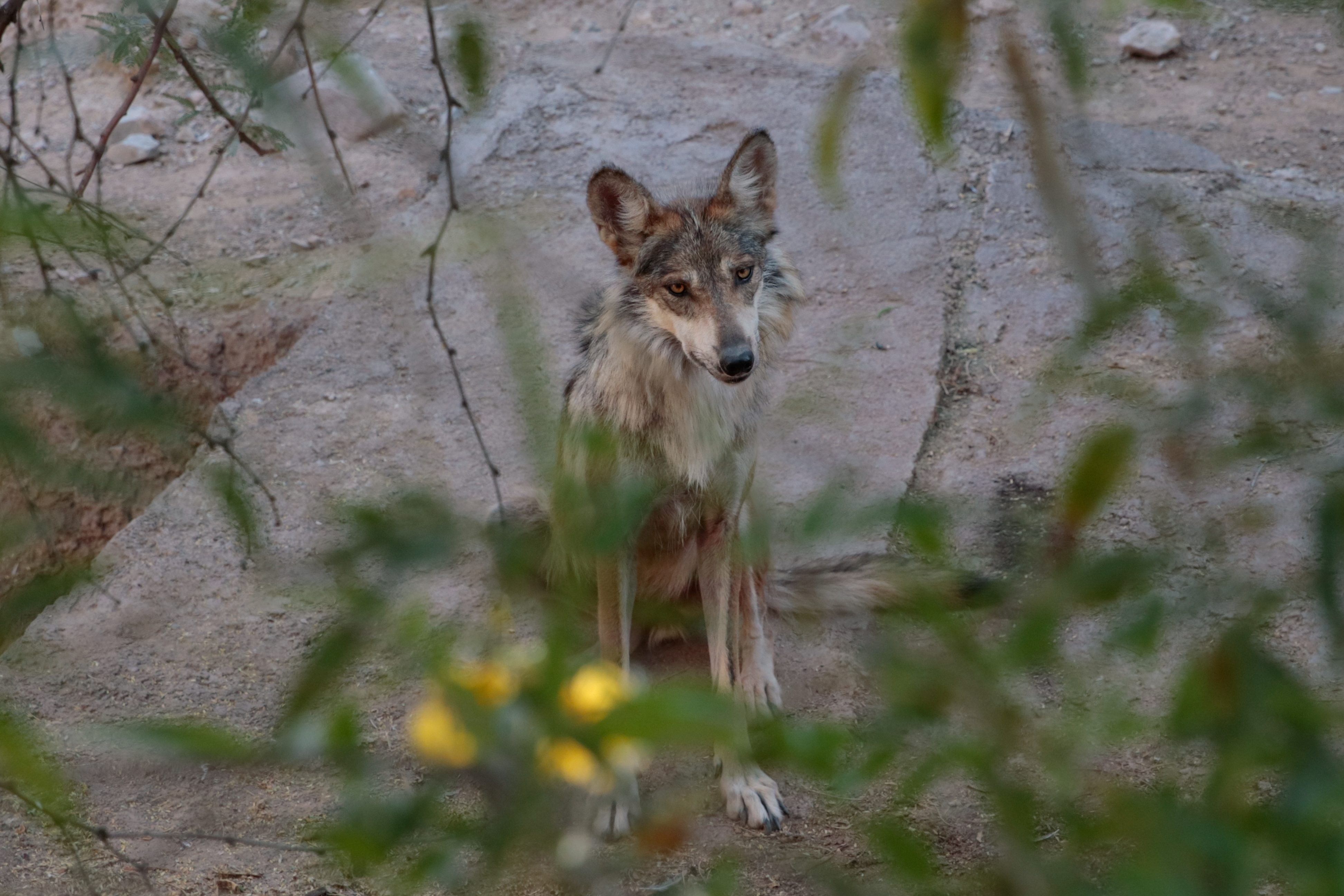
As evidenced by its common name, the Mexican gray wolf is native to northern Mexico, New Mexico, and our precious Sonoran Desert here in Southern Arizona. This subspecies is not only the rarest and most genetically distinct gray wolf in North America, but it is also under major threat. Once numbering in the thousands, conflicts with ranchers led to widespread hunting, trapping, and poisoning, pushing the species to near extinction by the 1980s.
In the Summer of 2022, U.S. and Mexican authorities signed an agreement to continue their collaborations to conserve, manage, and recover this endangered animal. Since then, recovery efforts in both countries have slowly grown the wild population, with an estimated 286 in the U.S. as of 2024. The ultimate goal is to establish a stable population of 320 wolves across the 4.4-million-acre Blue Range Wolf Recovery Area in southeast Arizona and southwest New Mexico.
The Role of Zoos and the Desert Museum
By the 1970s all known Mexican gray wolves were in the care of zoos and wildlife facilities in the United States and Mexico. Two of these wolves came to the Desert Museum between 1959 and 1960, founding what became known as the “Ghost Ranch” lineage—one of the three surviving lineages of Mexican gray wolves today.
The name “Ghost Ranch” may sound familiar—it is the name of famous Southwest painter Georgia O’Keeffe’s summer home and studio in Abiquiu, New Mexico, which the Museum’s co-founder Arthur Pack once owned. Local Tucsonans may also recognize it from the Ghost Ranch Lodge on Miracle Mile, which Pack built (and features a cow skull sign designed by O’Keeffe).
In 1978, a few remaining wild wolves were collected and became the McBride Lineage, named for Roy McBride, the hunter who trapped them. A third lineage, known as Aragon, was originally bred at the Chapultepec Zoo in Mexico City. All Mexican gray wolves alive today descended from seven unrelated founders of these three lineages.

Into the Wild
Although the Desert Museum no longer participates in the captive breeding program, we played a vital role in educating the public and policymakers about the ecological importance of wolves. This laid the groundwork for the eventual reintroduction of Mexican grey wolves into the wild in 1998.
Today, we provide a home for three post-breeding wolves—Sol, Luna and Estrella—who help us educate visitors about wolves’ role as a keystone species in the Sonoran Desert and inform ongoing efforts to restore them to the landscape.
New Wolf Exhibit
Expectations for animal exhibits continue to shift towards a more holistic approach to wellness, with an emphasis on keeping animals physically and psychologically healthy. Inspired by this, the Desert Museum has launched plans for a groundbreaking new wolf exhibit!
This new habitat will be nearly ten times the size of the current one, featuring design elements that allow the wolves to choose where to spend their time and encourage the same behaviors that they would exhibit in the wild.


Although exhibition design is underway, the Desert Museum, an independent 501(c)(3) nonprofit, still needs to fundraise for $1.2M from our community to reach the $5M goal required to complete this crucial project for the endangered Mexican gray wolf.
Please join us in making the new Mexican Gray Wolf exhibit possible! Donate here.
 Desert Diaries