By Jack Dash
The Sonoran Desert is known for its strange and wonderful organisms like giant saguaro cacti, resilient desert tortoises, scavenging vultures, venomous Gila monsters and rattlesnakes, and so many more. But did you know the desert is also home to a variety of fungi? In fact, you’ll find fungi everywhere, from deserts to tundra to marine habitats.
What is the difference between fungi and mushrooms? What are the different types of fungi? Do mushrooms grow in the desert, and where can I find them? Read on as we break it all down like a saprophyte. (Don’t worry, you’ll get the joke later!)
First, what’s a fungus? Fungi are contained in their own kingdom just like plants and animals. This large group of organisms are the principal decomposers on Earth. Though they are abundant, most fungi are inconspicuous or even invisible to humans, as they tend to live in soil or in decaying matter. However, most people have seen or eaten mushrooms!
So, what exactly are mushrooms? Think of them as the equivalent of apples on an apple tree. Mushrooms are the fruiting bodies of fungi that contain spores (think of them as fungi seeds) that will be blown in the wind or spread by animals to colonize a new area. Beneath the surface, an intricate network of string-like strands called mycelium make up the fungal organism itself, while the mushroom takes on the job of spreading its spores above-ground.
Fungi have various strategies for making a living. Some fungi form symbiotic relationships with other living organisms, sharing nutrients and moisture. Others colonize living tissue in a parasitic relationship (The Last of Us popularized a fictional version of this with the fungus cordyceps), and still others, known as saprophytic fungi, break down decaying matter, releasing nutrients into the surrounding landscape and enriching the soil.
From mycelium associated with the roots of trees and cacti to microscopic slime molds that decompose the tissue of dead saguaros, few people realize that the desert is actually full of fungal diversity! Below, we share three macrofungi (fungi that produce visible, relatively large, fruiting bodies) found in the Tucson region. Of these, two are saprophytes that break down decaying material, and our third species is an ectomychorrhizal fungi that partners with tree roots in a symbiotic relationship.
Battarea phalloides: sandy stiltball

Our first fungus friend is Battarea phalloides—the saprophytic sandy stiltball. The genus name Battarea honors an Italian mycologist (scientist who studies fungi), while the species name refers to the resemblance of this mushroom to…well nevermind. Like our other desert mushrooms, the sandy stiltball appears quickly following rains, most often in loose sandy soil such as that found around washes. The underground mycelium goes to work breaking down what organic matter it can find and eventually begins to develop the fruiting body.
When this mushroom emerges it is covered in a thin veil that protects the developing spores and often leaves a white membrane on the mushroom’s cap. A light touch of a mature fruiting body will send brown spores flying everywhere where they will settle in the soil and wait for the next bout of moisture to begin the process again. Though there is debate about this subject, some experts consider this fungus rare and even possibly endangered in parts of its broad global range though it is fairly common in our area when conditions are appropriate.
Podaxis pistallaris: desert shaggy mane


The other saprophytic fungus commonly encountered in the Tucson area is Podaxis pistallaris—the desert shaggy mane. This species will appear following rains and seems to be able to thrive in the most impossibly arid and barren spaces, even sometimes growing on top of anthills. Desert shaggy mane is found in deserts around the world including Africa, Australia, the Middle East, and of course the arid portions of North America. The stalk (called a stipe in mycology lingo) can be inches or just millimeters tall and the cap is bullet shaped and covered in soft scales.
The common name of this mushroom refers to the shaggy looking cap and the resemblance of this species to the widespread Coprinus comatus or common shaggy mane, a fungus that can be found in temperate areas around the globe. As quickly as this mushroom appears it will start to produce black spores and decompose, rapidly dissolving into an inky mass on the ground.
Astreus hygrometricus: hygroscopic earthstar
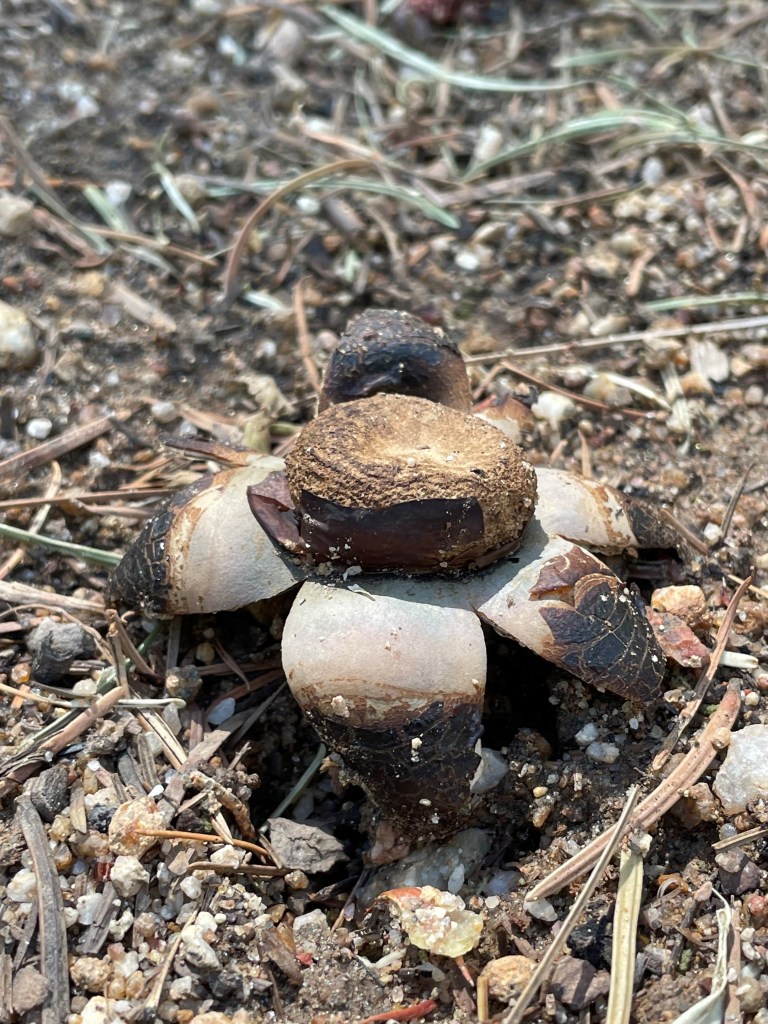
The other mushroom frequently seen around town is Astreus hygrometricus, the hygroscopic earthstar. The common name of this mushroom refers to the fact that it resembles a star with pointed appendages radiating out from the middle. When dry, these appendages fold over the cap only to open again when moisture is present. If you encounter one of these mushrooms in its closed state, simply sprinkle some water over the top and watch it fold out over the course of several minutes.
Unlike the other mushrooms we’ve discussed, this species is ectomychorrhizal, meaning that it attaches itself to the outside of tree roots in a mutually beneficial partnership where the tree provides the fungus with carbon and the fungus provides the tree with moisture and soil nutrients. This is a great trade for desert trees who are constantly searching for moisture in our dry soils.
Follow the Rain!
Though Tucson and the Sonoran Desert does not contain a huge diversity of charismatic macrofungi, these three species can reliably be encountered following rains. During the monsoon season, a trip to the higher elevation forests found on nearby peaks like Mt. Lemmon, Mt. Graham, and Mt. Wrightson will reveal a wealth of macrofungi, including beloved edible species like lion’s mane, oyster mushrooms, and porcinis. Aside from these charismatic macrofungi, the desert soil is underlain by a whole network of mycelium that supports plant growth. Look out for our next blog post, which will cover the fascinating world of desert mycelium!
 Desert Diaries
Awesome article!!
LikeLiked by 1 person