By Debra Colodner, Director of Conservation Education and Science, Arizona-Sonora Desert Museum
How does one do a checkup on a whole ecosystem? It takes a lot of doctors! Thirty-two, in the case of the latest report.
The report, Assessment of the Ecological Health of the Gulf of California, by Benjamin Wilder, Lorayne Meltzer, and Jorge Torre, summarizes the work of 41 different studies over the last two decades or more, and finds that parts of the system are doing well, while others are hurting. From the smallest marine animals (zooplankton, like krill and copepods) to whales, and from giant cacti to bats, each group of species has its own story to tell, and together suggest a diagnosis that is concerning, but with hope for recovery.
The report’s authors, all of whom have all worked in the Gulf for decades, were concerned by some of the changes they were seeing. Lorayne Meltzer (Prescott College Kino Bay Center), one of the lead authors, witnessed a decline in the productivity of some species of birds personally. “I knew that many of the more visible animals were declining, but didn’t have a comprehensive picture of the health of the whole system. We wanted to pull various long-term studies together in one place.”
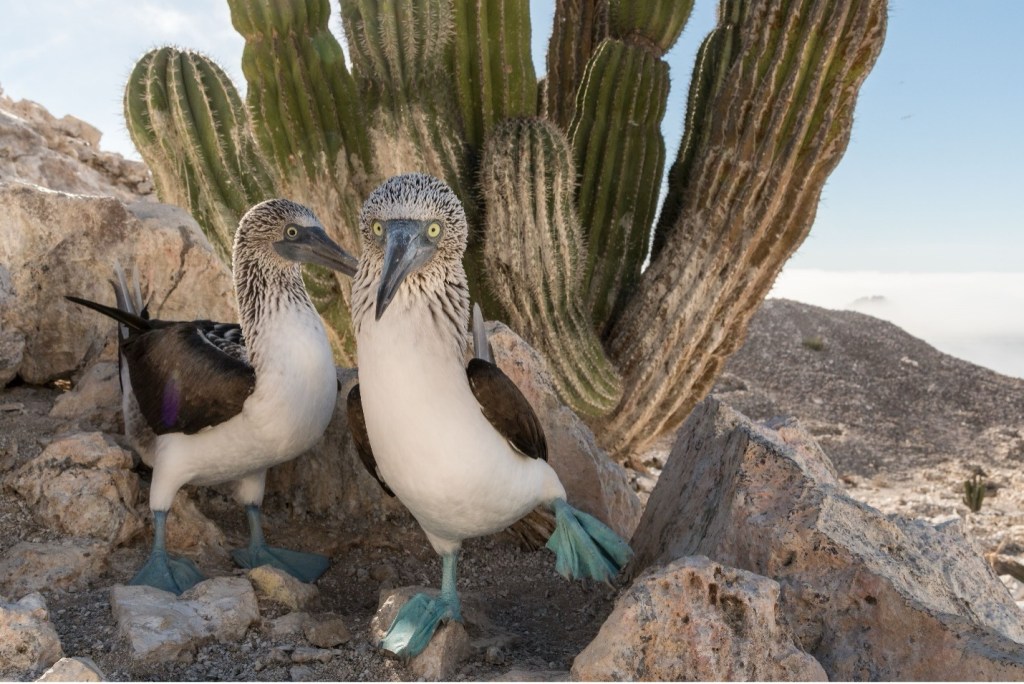
Blue-footed booby pair, Isla San Pedro Mártir. Photo by John (Verm) Sherman.
Out of the 41 groups of species studied, three were found to be improving, seven were stable, eleven were degrading, two were rapidly degrading, and eighteen had undetermined trends. The stable or improving species were all either terrestrial (like columnar cacti and beetles), had strong connections to the land (like fish-eating bats), or were at or near the base of the food web (like krill and copepods). In contrast, almost all of the animals higher up in their food webs (including fish, crabs, seabirds and whales) have declined over at least the last two decades.
Multiple Pressures on Gulf Ecosystems
Like the rest of the planet, the Gulf of California is experiencing numerous changes due to human activities. Over the last two decades, there have been unusually long ocean heat waves, coastal areas have been degraded by pollution and habitat destruction, habitats have been fragmented, and many fish populations have been over-harvested. Each of these changes has impacts throughout the ecosystem.
Specifically, responses to climate change are becoming more and more evident. For example, Humboldt squid, important for both people and sperm whales, declined dramatically after 2015. Spring winds have weakened, leading to less upwelling of nutrient-rich deep waters, and lower abundance of the squid’s favored prey. This has led to collapse of the Humboldt squid fishery and the loss of hundreds of jobs. Not finding squid, sperm whales have largely departed the Gulf, and may no longer be filling their former ecosystem role of apex predator. Sightings of other whales and dolphins around the Gulf have also decreased, and observations of emaciated individuals have increased.
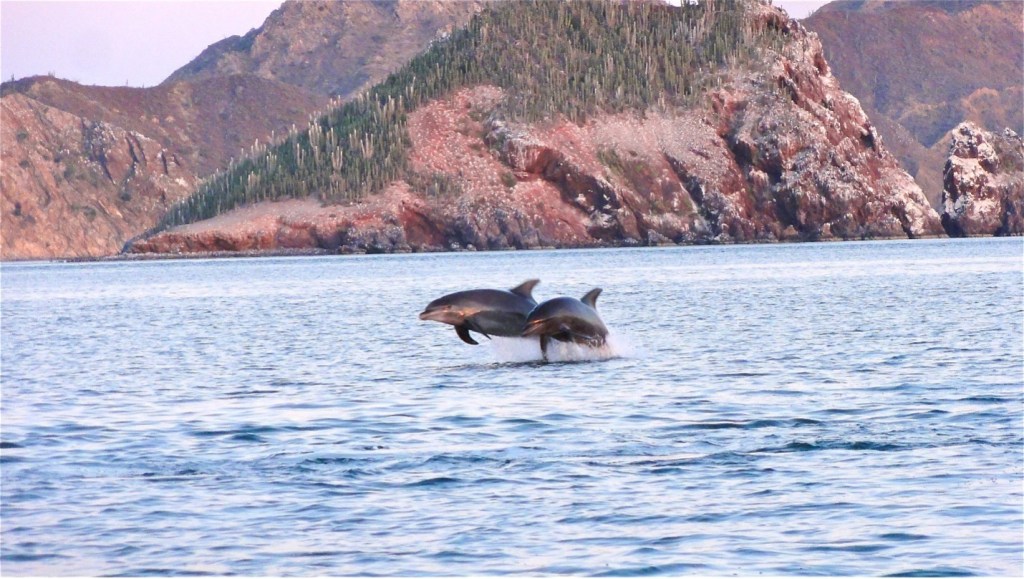
Dolphins in front of Islas Cholludo and Dátil. Photo by Ben Wider.
Rocky reef communities in the lower Gulf are also responding to climate change, especially the overall warming and extreme marine heat waves over the last decade. Invertebrates like corals and sea anemones, are “tropicalizing”, where tropical species are increasing in abundance, and temperate species are declining. Overall, invertebrates on the rocky reefs decreased in abundance by 35%. Studies around Isla San Pedro Mártir also showed declines in invertebrates.
Bright Spots
The news is not all bad though. Some of the most emblematic species of the Gulf seem to be faring well; fish-eating bats appear to be stable, and hawksbill sea turtles are improving. These endangered turtles are being helped by the conservation of mangrove forests in fishing refuges. Giant columnar cacti, cardons, are also doing very well on Isla San Pedro Mártir, home to the healthiest population of these cacti in the world.
The Gulf of California has some enduring natural features that provide resilience – the ability to resist and bounce back from disturbance. Strong tides flush out pollutants and bring in fresh ocean water from the Pacific. This seawater source is generally high in nutrients, feeding productivity in the Gulf. Rick Brusca, Executive Director Emeritus of the Desert Museum, notes that some of the problems the Gulf is facing now, including overfishing and pollutants that create low-oxygen “dead-zones”, are reversible, in theory. And he lauds the influence of Mexican civil society organizations and academics, who have been studying and working to protect the ecological health of the Gulf of California for decades.
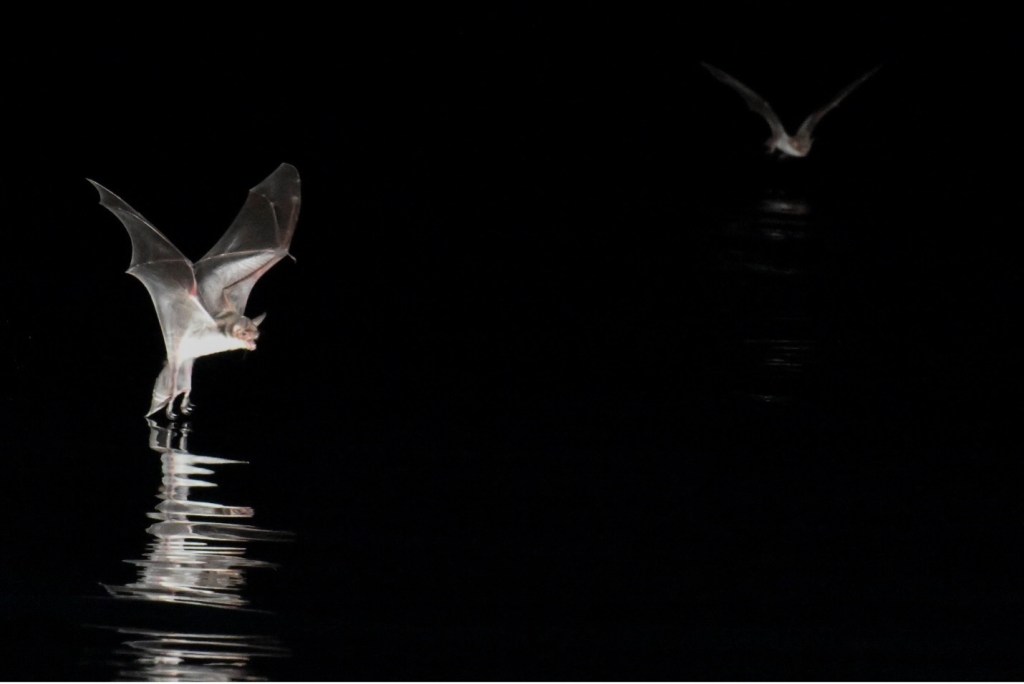
Fish eating bat (Myotis vivesi). Photo by Glenn Thompson.
For example, Pronatura Noroeste has been working with fishing communities and other governmental and non-governmental organizations around the Gulf of Santa Clara (in the northern Gulf of California), to raise awareness about and clean up discarded fishing nets and other plastic waste that entangle wildlife and are mistaken for food. In just one month in 2024 they collected 18-tons of trash. Just to the east, CEDO Intercultural engaged fishers in the Puerto Peñasco-Porto Lobos coastal corridor in developing a plan for local sustainable management of their fisheries, including community-based science and monitoring. And near the southern tip of Baja California Sur, the community of Cabo Pulmo banded together to advocate for protection of their coral reef in a National Marine Park, which was established in 1995. This allowed reef communities to recover and fulfill their multiple roles in supporting a healthy marine ecosystem. Residents successfully shifted to ecotourism as a new lower-impact source of income.
Desert-Ocean Connections
Ben Wilder (Next Generation of Sonoran Desert Researchers), one of the study’s lead authors, notes that “this report makes clear how connected desert and sea ecosystems are. For example, sea turtles and the larvae of shrimp and dozens of commercial fish species spend their early lives protected in the roots of mangrove forests. Seabirds are one of the primary vectors that control the flow of nutrients between ocean and land, shaping the life we see on the islands of the Gulf of California.” According to Wilder, “understanding these land-sea linkages is critical for conserving the Gulf’s biodiversity.”
This report is not a complete assessment, and the authors point out important gaps, such as assessment of any long-term changes in marine algae, open ocean fish, and the human social sphere. However, it is an important step forward that makes the findings of many researchers readily available to the public and to each other, allowing comparison and the generation of new questions and further study and action plans.
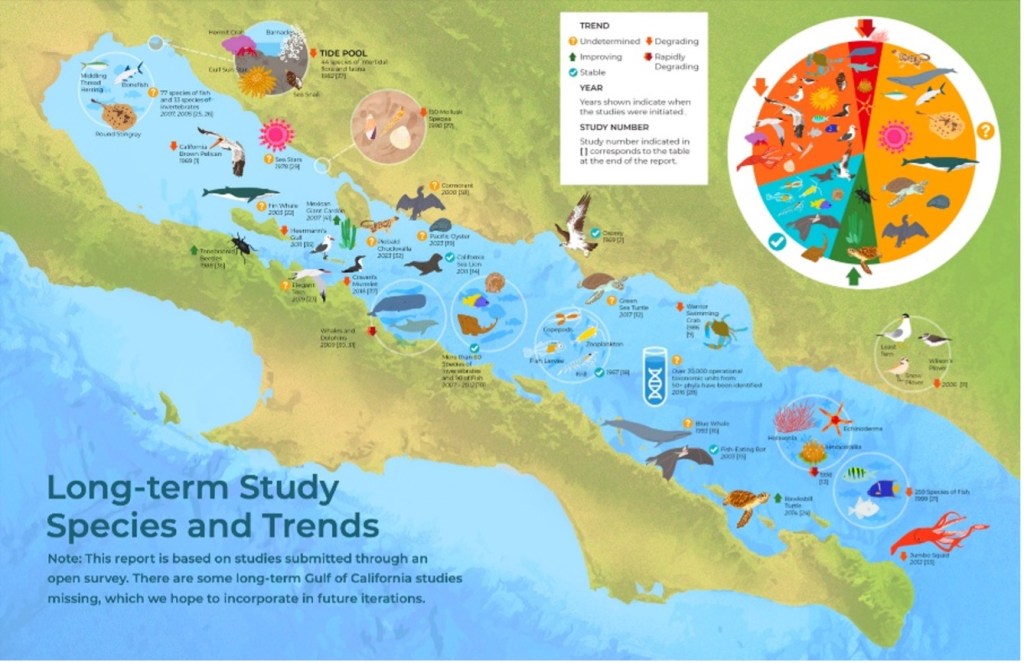
Gulf of California Trends. Illustration by Paola Ramirez.
The report outlines key areas where action can make a difference:
1. Protect High-Value Habitats
- Mangroves, estuaries, reefs, and desert islands need targeted protection.
- Support marine protected areas (MPAs) and expand their effectiveness through enforcement and community involvement.
2. Sustain and Expand Long-Term Monitoring
- Many of the most important findings come from long-term data — some stretching back over 50 years.
- Continued investment in science is critical to understanding how ecosystems respond to change and which interventions work.
3. Reduce Overfishing and Improve Fisheries Management
- Implement science-based quotas and community-led conservation.
- Support alternative livelihoods and education for fishing communities.
- Promote community science and local stewardship.
4. Integrate Traditional Knowledge
- Indigenous communities like the Comcaac (Seri people) hold valuable insights into ecosystem management.
- Support language preservation and education to help maintain this cultural-ecological knowledge.
5. Address Climate Change and Water Use
- Reduce greenhouse gas emissions to slow warming.
- Rethink water management in desert areas, which affects coastal ecosystems downstream.
- Restore natural hydrological flows that support estuaries and wetlands.
The original report can be downloaded in full here:
Assessment of the Ecological Health of the Gulf of California
 Desert Diaries